101Leafy researched the games.
World 1-2
- World
- World 1: Grass Land
- On the map
- Level, screen 1, row 1, column 9 (spot 2)
- Timer
- 300
- Areas
- 2

Drawn from the ROM's level data, with the areas side by side from left to right. Red boxes mark enemies, with a thick one for the boss. Yellow boxes mark ? blocks and dashed boxes bricks. The white box is the goal. A blue box marks the start of a screen whose pipes and doors lead somewhere. Dark green boxes mark platforms and light green boxes the other objects. Boxes link to their enemy, item, or object page, and the goal box to the goal cards. On a pipe or door, the box links to where it comes out.
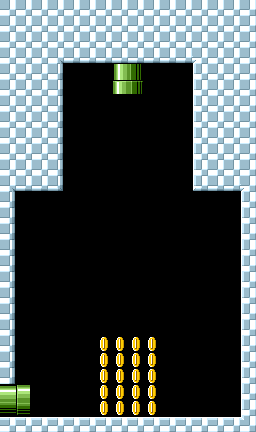
Area 3-AF2A in Super Mario All-Stars (SNES). Only the level layer is drawn; the enemies and the backdrop layers behind it are left out.

Area 1-BA49 in Super Mario All-Stars (SNES). Only the level layer is drawn; the enemies and the backdrop layers behind it are left out.
| Area | Tileset | Timer | Width |
|---|---|---|---|
| 3-AF2A | hills | 300 | 176 |
| 1-BA49 | plains | 300 | 16 |
Enemies
| Name | Id | Count |
|---|---|---|
| Little Goomba | 72 | 6 |
| Venus Fire Trap | A4 | 3 |
| Para-Goomba | 73 | 2 |
| Para-Goomba With Micro-Goombas | 74 | 1 |
? Blocks
| Id | Holds | Count |
|---|---|---|
| 61 | Super Leaf | 1 |
| 63 | Coin | 1 |
Contents from the block table in the ROM (bank 8, $B67D). A Fire Flower or Super Leaf block gives a Super Mushroom when Mario is small. The same items are drawn on the maps in Nintendo Power Strategy Guide: Super Mario Bros. 3 (Nintendo of America, 1990), p12-13, 13.
Bricks
| Id | Holds | Count |
|---|---|---|
| 70 | Switch Block | 1 |
Contents from the block table in the ROM (bank 8, $B67D). A Fire Flower or Super Leaf block gives a Super Mushroom when Mario is small. The same items are drawn on the maps in Nintendo Power Strategy Guide: Super Mario Bros. 3 (Nintendo of America, 1990), p12-13, 18.
Pipes and doors
Where Mario comes out after a pipe or door. Objects $E0-$EF in the level data give each screen a place in the next area: screen, column, and height. Every pipe or door on that screen leads to the same place.
- Blocks 65-80 from the left: this map, block 184 from the left, row 5 (area 1-BA49)
- Blocks 177-192 from the left: this map, block 61 from the left, row 21 (area 3-AF2A)
Objects
Object ids in the level data and how many of each. Only the platforms are named yet. The objects page says what each one does.
| Id | Count |
|---|---|
| C1 | 3 |
Super Mario All-Stars
In Super Mario All-Stars (SNES, NA), this level differs from the NES data in these places. To see what a change does, the All-Stars objects were put in the NES area and drawn with the NES loader. Blocks count from the left of the area, rows from the top.
- Area 3-AF2A: the layout ($24:BA90) leaves out 21 NES objects.
- Area 3-AF2A: 5 objects of a kind the NES game does not have ($24:BA90, drawn by $2A:B753): one tile, $20, $21, $24, or $25 by the low digit of its id (table $2A:B778).
- Area 3-AF2A: 6 objects of a kind the NES game does not have ($24:BA90, drawn by $2A:B787): a slanting line of one tile, $02 to $0D, one or two columns per row (tables $2A:B7EF and $2A:B7F9); the fourth byte is the length minus 1. Low digit 8 draws $22, goes down through $C2 tiles, and ends with $23 if it reaches $F5.
- Area 1-BA49: the layout ($24:9DBA) leaves out 6 NES objects.
- Area 1-BA49: 18 objects of a kind the NES game does not have ($24:9DBA, drawn by $2A:8674): a line of one tile ($13 to $22 by the low digit of its id, table $2A:86E5) going right, down, down-left, or down-right (table $2A:86D5); the fourth byte is the count, and when the low digit is 0 a fifth byte draws the line again on that many rows below.
Source: Super Mario All-Stars layout pointers $21:D8B3 and enemy pointers $21:D8A1
In the 百科 (2015)
A grassland level with many slopes. Goombas come out of pipes and walk down the slopes.
坂道の多い草原コース。土管から出てくるクリボーが坂道を歩いている。
Our translation of スーパーマリオブラザーズ百科 任天堂公式ガイドブック (Shogakukan, 2015) p38
From the magazines
Out of the pipes of this World flow a torrent of Goombas
Nintendo Power Volume 11 (Nintendo of America, March/April 1990) p10
The Switch Block and other hidden items will be in place again when you exit the secret room.
Nintendo Power Volume 11 (Nintendo of America, March/April 1990) p10
Found at last, endless (?) 1UP. First, go into 1-2 as しっぽマリオ. Stomp the Goombas coming one after another out of the pipe, again and again without a break. The trick is to stay in the air longer with the tail.
ついに発見、無限(?)1UP まず、1-2にしっぽマリオで突入だ。土管からつぎつぎに出てくるクリボーを、連続して何匹も何匹も踏みつぶす。しっぽを使って滞空時間をかせぐのがコツだ。
Our translation of BIWEEKLY ファミコン通信 (ASCII, 11 November 1988) p136
Ground stage, slopes. Slopes over the whole stage, a mood quite unlike anything before. Here 3 shows what it can do!?
地上面・坂 全面坂、坂で今までとはまったく変わったフンイキ。いよいよ「3」の本領発揮!?
Our translation of スーパーマリオブラザーズ3 マガジン Vol.2, ファミリーコンピュータMagazine 1988 No.18 supplement (Tokuma Shoten, 7 October 1988) p4
Gentle slopes like these are one of the things to see in 3. Sliding down a slope with Down on the + Control Pad feels good, but there are plenty of ways to go wrong.
こんなふうになめらかな地形パターンが出てくるのも「3」の見どころ。坂を十字ボタンの下でツツーッとスベリ降りるのは気持ちいいんだけど、行きすぎちゃって穴に落ちちゃったり、敵に当たったりミスもいろいろ。
Our translation of スーパーマリオブラザーズ3 マガジン Vol.2, ファミリーコンピュータMagazine 1988 No.18 supplement (Tokuma Shoten, 7 October 1988) p4
Mario slows down going up a slope.
坂をのぼる時はマリオのスピード減少
Our translation of スーパーマリオブラザーズ3 マガジン Vol.2, ファミリーコンピュータMagazine 1988 No.18 supplement (Tokuma Shoten, 7 October 1988) p4
Sliding speeds you up! Knock the Goombas flying!
すべる時はスピードアップ! クリボーなんかははねとばしちゃえ!
Our translation of スーパーマリオブラザーズ3 マガジン Vol.2, ファミリーコンピュータMagazine 1988 No.18 supplement (Tokuma Shoten, 7 October 1988) p5
Stomp the note block and a star comes out. Can you get it?
音符ブロックをふんづけたらスターが出現。取れるカナ?
Our translation of スーパーマリオブラザーズ3 マガジン Vol.2, ファミリーコンピュータMagazine 1988 No.18 supplement (Tokuma Shoten, 7 October 1988) p5
Enemies come out one after another from the pipe on top of the slope.
坂の上の土管の中から敵がゾクゾクと登場してくる。
Our translation of スーパーマリオブラザーズ3 マガジン Vol.2, ファミリーコンピュータMagazine 1988 No.18 supplement (Tokuma Shoten, 7 October 1988) p5
1-2 key points. A pipe in an odd place in 1-2. There was a secret past it.
1-2 攻略ポイント 1―2のヘンな場所にあった土管。その先に実は秘密があったんだけれど……。
Our translation of スーパーマリオブラザーズ3 マガジン Vol.3, ファミリーコンピュータMagazine 1988 No.19 supplement (Tokuma Shoten, 21 October 1988) p21
Build a foothold with the P Switch. Press the switch hidden under the pipe and the coins turn into blocks, so you can climb up. Go into the pipe while they are still blocks.
Pスイッチで足場を造れ 土管の下に隠れたスイッチを押すと、コインがブロックになって上へ行けるぞ。/ここに実はPスイッチが。これを押すとコインが変身/ブロックに変化しているうちに土管に入ろう
Our translation of スーパーマリオブラザーズ3 マガジン Vol.3, ファミリーコンピュータMagazine 1988 No.19 supplement (Tokuma Shoten, 21 October 1988) p21
A tall, narrow pipe stage. Inside are a full 20 coins.
縦に長い土管面。中にはコインがたっぷり20枚あるぞ
Our translation of スーパーマリオブラザーズ3 マガジン Vol.3, ファミリーコンピュータMagazine 1988 No.19 supplement (Tokuma Shoten, 21 October 1988) p21
A ground stage full of slopes. A ground stage where slopes and Little Goombas come out in numbers. The Para-Goombas' attacks and the Piranha Plants' fire will make you cry. Raccoon Mario recommended. TIME 300, difficulty two stars, value one star.
坂がいっぱいの地上面 坂とクリボーがたくさん出てくる地上面。パタクリボーの攻撃やパックンの炎に泣かされるぞ。しっぽがおすすめ。TIME 300 難易度☆☆ お得度☆
Our translation of スーパーマリオブラザーズ3 マガジン Vol.4, ファミリーコンピュータMagazine 1988 No.20 supplement (Tokuma Shoten, 4 November 1988) p4
Don't take the coins: hit the switch under the pipe.
コインを取らずに土管の下のスイッチを。
Our translation of スーパーマリオブラザーズ3 マガジン Vol.4, ファミリーコンピュータMagazine 1988 No.20 supplement (Tokuma Shoten, 4 November 1988) p4
A leaf from the note block. At first it is safer to beat the Para-Goomba below before you bring it out.
音符ブロックからはっぱ。下にいるパタクリボーを倒してから出したほうが最初のうちは無難だ。
Our translation of スーパーマリオブラザーズ3 マガジン Vol.4, ファミリーコンピュータMagazine 1988 No.20 supplement (Tokuma Shoten, 4 November 1988) p5
If you step on the note block to bring out the star, it can fall into the pit below. Hit it from below to bring it out.
音符をふんでスターを出すと、下の穴に落ちちゃうことも。下から叩いて出すようにしよう。
Our translation of スーパーマリオブラザーズ3 マガジン Vol.4, ファミリーコンピュータMagazine 1988 No.20 supplement (Tokuma Shoten, 4 November 1988) p5
Jump down a long way from the left and there is a Para-Goomba. Take care not to run into it!
左から大きく飛びおりるとパタクリボー。激突しちゃわないよう注意!
Our translation of スーパーマリオブラザーズ3 マガジン Vol.4, ファミリーコンピュータMagazine 1988 No.20 supplement (Tokuma Shoten, 4 November 1988) p5