101Leafy researched the games.
Phases
From the phase script at ROM $E0D0. Enemies are listed in the order they come out of the pipes. The phase 8 bonus is on the ice floor (floor 4). Slipice come from phase 9. After phase 22 the script's end byte ($FF) sends the game back to phase 18.
Every enemy starts a phase at speed level 0. When the phase's list is used up and one enemy is left ($46, set at $C77D), a Sidestepper goes to level 5 and a Shellcreeper to 1 pixel every frame ($C711). A Fighter Fly keeps its speed. The green fireball countdown ($04F3) is also cut to 4 counts if it is higher ($E795).
Phase layouts
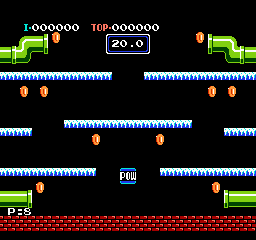
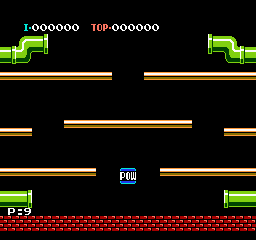
Screens taken by running the NES ROM, one for each kind of floor. The bonus phases keep the timer box from before the clock starts, and their ten coins.
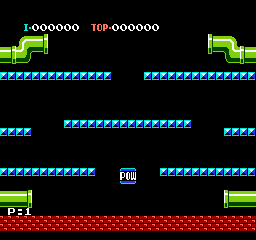
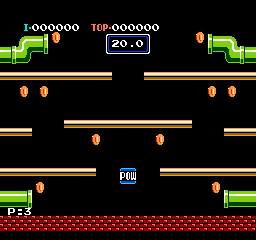
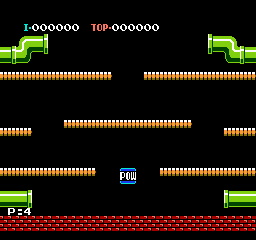
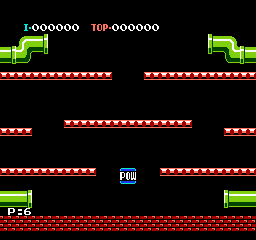
Fireballs
The fireball columns above are the row each phase uses. Countdown starts are at ROM $F081 (green) and $F089 (red); Game B reads four entries further on. The countdowns go down by one each time the frame counter $27 reaches 62 ($E719), so one count is 62 frames, about 1.03 seconds. At 0 the fireball comes out. A red fireball that has been put out starts again from the same row's value ($EC44-$EC63).
| Row | Green fireball, Game A | Seconds | Green fireball, Game B | Seconds |
|---|---|---|---|---|
| 0 | 40 | 41.3 | 15 | 15.5 |
| 1 | 30 | 30.9 | 10 | 10.3 |
| 2 | 10 | 10.3 | 7 | 7.2 |
| 3 | 5 | 5.2 | 3 | 3.1 |
| Row | Red fireball, Game A | Seconds | Red fireball, Game B | Seconds |
|---|---|---|---|---|
| 0 | 50 | 51.6 | 30 | 30.9 |
| 1 | 50 | 51.6 | 30 | 30.9 |
| 2 | 40 | 41.3 | 28 | 28.9 |
| 3 | 38 | 39.2 | 18 | 18.6 |
| 4 | 30 | 30.9 | 40 | 41.3 |
Mario Bros. Classic (1993)
The 1993 Classic release in Europe is a rewritten program with its own phase script (ROM $9FDB, read at $C286). Its records are laid out the same way as the NES ones, but phase 3 is a normal phase. The bonus phases are 4, 9, 16, and 23. The bonus floors of phases 16 and 23 are not drawn (bit 7 of the floor byte, $C299). Slipice come from phase 10 ($C2EE), and the POW is refilled from the phase 9 bonus. The end of the script ($A037) goes back to phase 18.
Enemy introductions
Before the phase where a new enemy comes in, the Classic release shows a screen with its name (ROM $C26B, read at $C270): SHELLCREEPER before phase 1, SIDESTEPPER ("1ST HIT MAKES IT MAD") before phase 5, FIGHTERFLY before phase 7, and SLIPICE before phase 10. The NES game has no such screen.
Icicles
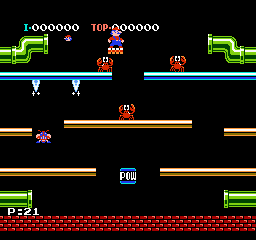
The NES and Famicom game has no icicles: neither instruction booklet shows one, and ファミリーコンピュータ必勝本 (JICC出版局, 1985) p94 lists no icicle among the enemies. The Classic release adds them from phase 17. They form under the top floor and drop. Their number goes in $0720 ($C2F5-$C302): one in phases 17 to 20, two in 21 to 30, three in 31 to 40, and four from phase 41.
In the magazines and the arcade manual
The screen is built in four tiers, and there are 28 patterns in all. The enemies come out one after another at the top left and right, and go into the pipes at the bottom left and right.
画面は四段の階層状で、全部で二十八パターンまである。敵は上部左右から次々と現われては下部左右のパイプの中へ入っていく。
Our translation of ゲームマシン No.215 (Amusement Press, July 1, 1983) p22
The 28 patterns are the arcade game's count. The Famicom and NES phase script has 22 phases, then repeats 18 to 22 (ROM $E0D0).