101Leafy researched the games.
Super Mario Land
スーパーマリオランド
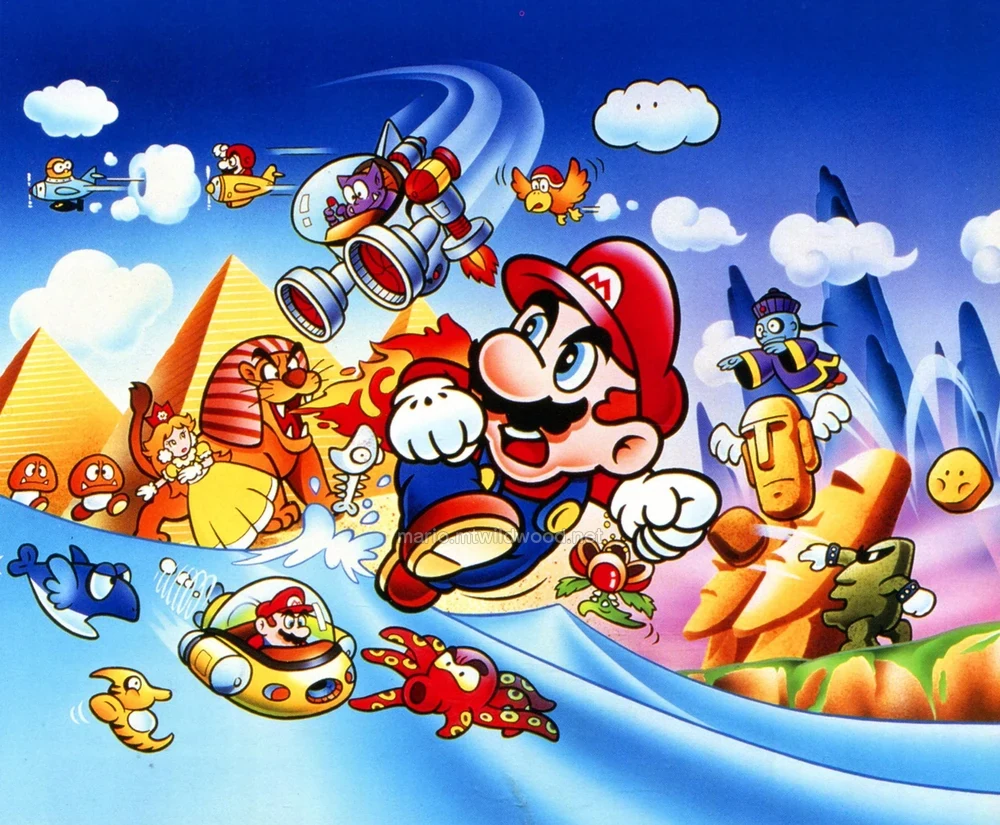
A Game Boy game from 1989. Mario crosses the four kingdoms of Sarasaland to rescue Princess Daisy from the space monster Tatanga. World 2-3 is played in the Marine Pop submarine and World 4-3 in the Sky Pop airplane, both as shooting areas.
Once upon a time, there was a peaceful world called Sarasaland. In this world there were 4 kingdoms named Birabuto, Muda, Easton and Chai. One da
Super Mario Land Instruction Booklet (Nintendo, 1990) p3
Every page here comes from 101Leafy's research in the official books and Nintendo's own site for the game: the Japanese instruction booklet (1989), the UK instruction booklet (1990), Nintendo Power for November/December 1989, Club Nintendo Classic No. 1 (1990), the Nintendo Player's Guide: Game Boy (1991), the Nintendo Player's Guide: Super Game Boy (1994), the two GAMEBOY Magazine supplements to ファミリーコンピュータMagazine (Tokuma Shoten, 1989), and the スーパーマリオブラザーズ百科 (Shogakukan, 2015). Each line carries its book and page. Lines from the Japanese booklet, site, magazines, and 百科 are our translation.
From other books
April 21, 1989, Game Boy. Super Mario Land. A side-scrolling action game released at the same time as the Game Boy itself. It takes place in Sarasaland (see pp44 on).
スーパーマリオブラザーズ百科 (Shogakukan, 2015) p239, our translation
Game Boy: the hit game machine that opened up the handheld market. The first model had a black and white screen; the Game Boy Color (GBC) came later. Released April 21, 1989.
スーパーマリオブラザーズ百科 (Shogakukan, 2015) p238, our translation
DIRECTORY OF GAME BOY GAMES
Super Mario Land: 1P, Adventure, 9/89, Nintendo. GAME BOY TOP TEN: 9. Super Mario Land. The rankings above are from the Pros at Nintendo HQ.
Nintendo Power, September/October 1990 (Nintendo of America) p62
GAME BOY TOP 10
1. Super Mario Land. Game Boy Top 10 rankings are determined by the votes of the Pros at Nintendo HQ, sales at NES retailers and the votes by readers of Nintendo Power.
Nintendo Power, January 1991 (Nintendo of America) p71
From the magazines
At heart this is a Super Mario-type action game where you keep heading right through side-scrolling maps. What's in it is pure Mario too: grab a Mushroom to power up, collect coins for a 1UP, that sort of thing.
BIWEEKLY ファミコン通信 1989 No. 10・11, May 12 and 26 combined issue (ASCII, 1989) p128, our translation
This time Mario rides a submarine and a propeller plane and plays shooting games.
BIWEEKLY ファミコン通信 1989 No. 10・11, May 12 and 26 combined issue (ASCII, 1989) p128, our translation
This one is well made. People everywhere say the ghosting makes the Game Boy a poor fit for action games, but this Mario gets pretty close, I think. They did well to get this far. The music is good too. It still falls short of the Famicom, though. (6 points of 10)
BIWEEKLY ファミコン通信 1989 No. 12, June 9 (ASCII, 1989) p12, our translation
Of the games released with the Game Boy itself, Mario Land is the best made. Still, it's an LCD screen, so the characters flicker with ghosting, and long sessions make your eyes hurt. (7 points of 10)
BIWEEKLY ファミコン通信 1989 No. 12, June 9 (ASCII, 1989) p12, our translation
It has fewer stages than the Famicom Mario games, but given what the Game Boy is, a game you can finish in a short time is probably better. Mario blurs and is sometimes a little hard to see, but there are new characters too, and it's a lot of fun. (7 points of 10)
BIWEEKLY ファミコン通信 1989 No. 12, June 9 (ASCII, 1989) p12, our translation
The maps are laid out more meanly than in the original Super Mario. It feels like they want you to die right here. Next to the first Super Mario, Mario's movement feels cheap, and the enemies aren't appealing. A black and white Mario is a bit lonely. (6 points of 10)
BIWEEKLY ファミコン通信 1989 No. 12, June 9 (ASCII, 1989) p12, our translation
Fun that only Mario Land has, and the Famicom Super Mario didn't: the shooting stages.
BIWEEKLY ファミコン通信 1989 No. 12, June 9 (ASCII, 1989) p136, our translation
Each World has three Areas, and at the end of the third the World's boss lies in wait, so every World has a different boss. And one of the big new features is that 2-3 and 4-3 are auto-scrolling shooting games.
ファミリーコンピュータMagazine 1989 No. 7, April 7 (Tokuma Shoten, 1989) p72, our translation
Mario Land has finally passed its big brother Mario 3 and taken first place.
BIWEEKLY ファミコン通信 1989 No. 13, June 23 (ASCII, 1989) p10, our translation
The Game Boy's Mario Land enters the readers' chart at 12th. It's doing great in the TOP30 too, and looks set to threaten the top spots.
BIWEEKLY ファミコン通信 1989 No. 15, July 21 (ASCII, 1989) p8, our translation
Worlds and levels
Bosses



Where the books disagree
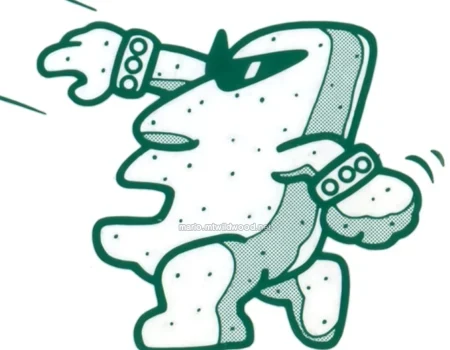
- Mekabon: the Japanese manual p15 says stomping its flying head won't beat it; the UK booklet p14 says it "can be beaten by jumping on its head"; the Player's Guide p8 says to "stomp the robot before it attacks", and ファミリーコンピュータMagazine No. 7 p78 says stomping beats it. The 百科 p47 sides with the Japanese manual.
- The bonus game: the Japanese manual p5 says only "the button" and adds that the Flower is a miss for Superball Mario; the UK booklet p7 says the B Button; the Player's Guide p4 and ファミリーコンピュータMagazine No. 7 p78 say the A Button.
- The end of each world: both manuals have Mario step on a switch (スイッチ, "switch"); the Player's Guide p7 says "Jump to the axe".
- The Player's Guide p10 opens World 3-3 with "The Chai Kingdom's castle"; World 3 is the Easton Kingdom.
- Tamao: the manuals call it a life form that can't be killed (不死身, "indestructible"); the Player's Guide p5 calls it a jellyfish.
- Spellings in the Player's Guide: Nobokon (Nokobon), Gina and Giras (Gira), Chikaka on p5 and Chikako on p11, Pinopi (Pionpi), Nyolin (Nyololin), Honhen (Honen), Brokinton (Biokinton), Rocketon (Roketon), Reverse Pakkun (Upside Down Pakkun), Dragonmasu on p8 (Dragonzamasu).
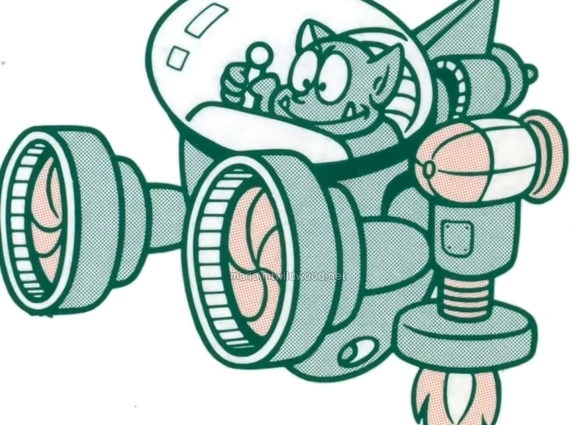
- Japanese and UK names that differ in more than spelling: ブラックピヨン is Kumo, パオキントン is Biokinton, フーライ is Fly, and the war robot パゴス is Pagosu. The Japanese manual writes ピラプト (Birabuto), ミューダ (Muda), パタドン (Batadon), and メカポン (Mekabon).
- Biokinton: only the Japanese manual p21 says the Chicken have taken it over as their nest; the Player's Guide p5 calls it a cloud that "conceals a Chicken dispenser".
- King Totomesu: Nintendo Power (November/December 1989) p53 calls the World 1-3 boss "the level leader, Gao", with the same five Superball hits. In the Player's Guide p7, Gao (ガオー) is a different enemy met earlier in the same level. The official site writes キング・トドメス, the Japanese manual キング・トトメス.
- Mekabon: the official site's character page gives 800 points; the Japanese manual p15 gives 400.
- Pakkun Flower: the official site gives it 400 points and repeats the Upside Down Pakkun's line under it; the Japanese manual p13 gives the Pakkun Flower 100 points and its own line.
- Kumo: the official site and the 百科 p47 write ブラックピョン, the Japanese manual ブラックピヨン. The 百科's World 3-2 line on p48 writes ブロックピョン.
- Hiyoihoi: the Japanese manual writes ヒョイホイ, and so does the 百科's World 3-3 line on p48; the 百科's enemy list on p47 writes ヒヨイホイ.
- The switch behind each boss: both manuals and the official site say it opens the gate to the next World; the 百科 p48 calls it ボス撃破スイッチ ("boss defeat switch") and says stepping on it beats the boss.
- The UK booklet p16 prints the Fly's line as "You can defeat it down by jumping on it."
- The switch behind King Totomesu: the Super Game Boy Player's Guide p17 says flipping the lever "will send Totomesu sinking", as the 百科 p48 does; both manuals say the switch opens the gate.
- Hiyoihoi: the Super Game Boy Player's Guide p18 says "Hiyohoi can't be defeated"; the Japanese manual p16 and the UK booklet p15 say ten superballs beat it.
- Where Daisy is held: the Japanese manual p1 and the UK booklet p3 name the Chai Kingdom; the Super Game Boy Player's Guide p16 says "no one knows exactly where Daisy is being held".
- Hiyoihoi: Club Nintendo Classic p8 calls it a "direct descendant from a Tokotoko statue"; the manuals make it a Tokotoko that evolved.
- Biokinton: Club Nintendo Classic p9 calls it "a coward"; the Japanese manual p21 says it is shy, and the UK booklet p17 speaks of its shyness.
- Spellings in Club Nintendo Classic (pp6-9): Nobokon (Nokobon), Dragon Zamasu (Dragonzamasu), Pom Pom Flower (Pompon Flower), PAGOSU, and both Sky Pop and Sky-Pop.
- Spellings in the Super Game Boy Player's Guide (pp16-19): Hiyohoi (Hiyoihoi), PomPom (Pompon Flower), Pakkun (Pakkun Flower), Nyolin (Nyololin), Dragon Zamasu (Dragonzamasu), and Totomesu without King.
- GAMEBOY Magazine (1989 No. 9 supplement) p5 calls the turtle in World 1-2 ノコノコ (Nokonoko); the same page and its enemy list on p7 write ノコボン (Nokobon), as the manuals do.
- Mekabon: GAMEBOY Magazine p11 and ファミリーコンピュータMagazine No. 7 p81 write メカボン and give 800 points, as the official site does; the Japanese manual p15 writes メカポン and gives 400.
- Batadon: GAMEBOY Magazine p13 writes バタドン; the Japanese manual writes パタドン.
- Honen: GAMEBOY Magazine's enemy list p11 puts it in Areas 2 and 3 of World 2, but the same magazine's World 2-1 tip on p9 has Honen leaping out of the sea, as the Player's Guide does. ファミリーコンピュータMagazine No. 7 has Honen in 2-1 (p79) and 2-3 (p81).
- Pakkun Flower: GAMEBOY Magazine p7 gives 100 points, as the Japanese manual does; the official site gives 400.
- The switch behind King Totomesu: GAMEBOY Magazine p6 says pressing it opens the door to the room beyond, as the manuals do, not that it beats the boss as the 百科 and the Super Game Boy Player's Guide say.
- SELECT: ファミコン通信 No. 10・11 p128 says SELECT isn't used; the official site's secret info page has it move the mushroom on the continue screen, and ファミコン通信 No. 13 p148 prints a course select that opens once Daisy is rescued and the second quest is cleared.
- Firing in the shooting stages: ファミコン通信 No. 10・11 p128 gives only the A Button for torpedoes and missiles; Club Nintendo Classic p6 has A fire a series and B a single shot.
- Nyololin: ファミリーコンピュータMagazine No. 7 p73 says it appears in World 3; the Player's Guide p5 lists it under World 4.
- The end of Worlds 1 and 2: ファミリーコンピュータMagazine No. 7 pp76 and 80 say the passage opens on its own (自動的に) once King Totomesu or Dragonzamasu is beaten, and shows no switch; both manuals have a switch open the gate, and the 百科 p48 has the switch beat the boss.
- Yurarin-boo: GAMEBOY Magazine p8 and ファミリーコンピュータMagazine No. 7 p81 write ユラリンプー; the Japanese manual writes ユラリン・プー.
Books
- スーパーマリオランド instruction booklet (Nintendo, 1989)
- Super Mario Land Instruction Booklet (Nintendo, 1990)
- Nintendo Player's Guide: Game Boy (Nintendo of America, 1991)
- Nintendo Power, November/December 1989 (Nintendo of America)
- スーパーマリオランド, Nintendo's official site
- スーパーマリオブラザーズ百科 (Shogakukan, 2015)
- Club Nintendo Classic No. 1 (Nintendo of Europe, 1990)
- Nintendo Player's Guide: Super Game Boy (Nintendo of America, 1994)
- GAMEBOY Magazine, ファミリーコンピュータMagazine 1989 No. 9 supplement (Tokuma Shoten, 1989)
- GAMEBOY Magazine Vol. 2, ファミリーコンピュータMagazine 1989 No. 14 supplement (Tokuma Shoten, 1989)
- ファミリーコンピュータMagazine 1989 No. 7, April 7 (Tokuma Shoten, 1989)
- BIWEEKLY ファミコン通信 1989 No. 10・11, May 12 and 26 combined issue (ASCII, 1989)
- BIWEEKLY ファミコン通信 1989 No. 12, June 9 (ASCII, 1989)
- BIWEEKLY ファミコン通信 1989 No. 13, June 23 (ASCII, 1989)
- BIWEEKLY ファミコン通信 1989 No. 14, July 7 (ASCII, 1989)
- BIWEEKLY ファミコン通信 1989 No. 15, July 21 (ASCII, 1989)
- Nintendo Power, September/October 1990 (Nintendo of America)
- Nintendo Power, January 1991 (Nintendo of America)