101Leafy researched the games.
The Lost Levels World 9-1
スーパーマリオブラザーズ2 ワールド9-1
- Timer
- 400 (the area header's value, counted down as in other worlds; the No.11 booklet's screen shows no number, while the 9-1 screen in スーパーマリオブラザーズ百科 (小学館, 2015) p.30 shows TIME 305)
- Map
- 1: ground · 2: water
- Hard mode
- yes
- Enemies
- Little Goomba · Koopa Troopa · Koopa Paratroopa · Buzzy Beetle · Hammer Brother · Lakitu · Spiny · Piranha Plant · Blooper
- Items
- Coin
- Printed maps
- スーパーマリオブラザーズ2 完全攻略法, booklet in ファミリーコンピュータMagazine 1986 No.11 (徳間書店, 1986) p.98-101 · ファミリーコンピュータMagazine 1986 No.10 (徳間書店, 1986) p.70-71 · ファミコン必勝本 No.005 (JICC出版局, 1986) p.72

Map 1 in Super Mario All-Stars (SNES). Only the level layer is drawn; the enemies and the scrolling backdrop layer behind it are left out.
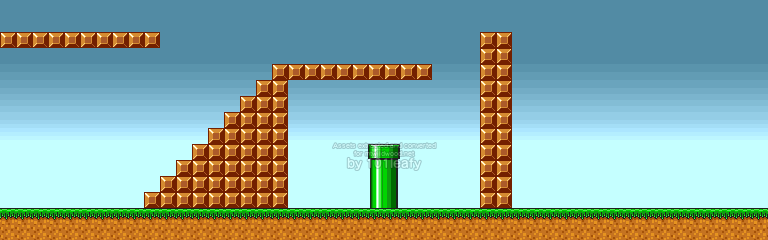
The world 9 maps were rebuilt with bank 1's tables over bank 2's level data. That is a trait of the cartridge conversion. The disk game does not have it. The No.11 booklet says the controls are those of a water area while the enemies move as on land (スーパーマリオブラザーズ2 完全攻略法, booklet in ファミリーコンピュータMagazine 1986 No.11 (徳間書店, 1986) p.98, our translation). More on world 9
In the books
「このワールド9では、それまでにマリオやルイージが何人残っていても1人に減らされてしまう。」
"In world 9, however many Marios or Luigis you had left, you are cut down to one." (our translation)
「ワールド9のアタマは、いきなりのワープゾーン。」
"World 9 opens with a warp zone, straight away." (our translation)
「地上のように思えるが水中という、少し不思議なコース。」
"A slightly strange level that looks like ground but is under water." (our translation)
On the map
Map 1: ground
- page 1: Piranha Plant
- page 1: Pipe, to Map 2, page 0
Map 2: water
- page 1: ? block, coin
- page 1: ? block, coin
- page 1: ? block, coin
- page 1: ? block, coin
- page 1: ? block, coin
- page 1: ? block, coin
- page 1: Koopa Paratroopa (red, flying up and down)
- page 2: Short lift going down
- page 2: Koopa Paratroopa (red, flying up and down)
- page 4: Koopa Paratroopa (green, flying left and right)
- page 5: Koopa Paratroopa (green, flying left and right)
- page 5: Lakitu
- page 5: 3 Koopa Troopas, row 11
- page 6: 2 Little Goombas, row 11
- page 7: Hammer Brother
- page 8: Blooper
- page 8: Blooper
- page 8: Buzzy Beetle
- page 9: Buzzy Beetle
- page 9: Koopa Paratroopa (green, jumping)
- page 9: Koopa Paratroopa (green, jumping)
- page 0: Piranha Plant
- page 2: Piranha Plant
- page 4: Piranha Plant
- page 2: Upside-down pipe
- page 3: Upside-down pipe
- page 10: Flagpole
- page 9: Frenzy: stop
Poison mushrooms, wind, and upside-down pipes
| What | Where | ROM |
|---|---|---|
| Upside-down pipe | Map 2, page 2 | $CB6C |
| Upside-down pipe | Map 2, page 3 | $CB72 |
Pipes and exits
| From | To | ROM |
|---|---|---|
| Map 1, page 0 | Map 2, page 0 | $CA90 |
Objects
| What | Count |
|---|---|
| Staircase | 2 |
| Terrain change | 8 |
| Block row | 4 |
| Pipe, enterable | 1 |
| Scroll stop | 2 |
| Block column | 6 |
| Pipe | 3 |
| ? block row, row 7 | 1 |
| Platform | 3 |
| Lift rope | 1 |
| Upside-down pipe | 2 |
| Brick row | 2 |
| Frenzy: stop | 1 |
| Flagpole | 1 |
| Castle | 1 |
Super Mario All-Stars
In Super Mario All-Stars (SNES, NA), this level differs from the NES data in these places. Map numbers are the ones on the map above. To see what a change does, the All-Stars objects of NES kinds were put in the NES area and drawn with the NES code. Columns count from 1 at the left of the area; rows count from the top as the NES data does, with the top row as row 0.
- Map 1: matched by shared objects; the All-Stars area differs a lot.
- Map 1: the area header is 50 31 in place of 50 02 ($0E:E560, read at $0E:C41D), which changes the terrain pattern from 2 to 1, so the filled rows go from 0 and 11-12 to 11-12 ($0D:A145) and the background scenery from 0 to 3 (the trees and fence, $0D:A177).
- Map 1: the layout ($0E:E560) has no terrain change at column 30.
- Map 1: the layout ($0E:E560) adds block row at column 1 and block column at columns 31, 32, and 17.
- Map 1: drawn with the NES code, the solid blocks differ at columns 11-15 and 33-48.
Source: Super Mario All-Stars area pointers $0E:C582/$0E:C5C9 and enemy pointers $0E:C4F0/$0E:C537
Sources
- Level table $C384 of the mapper 40 conversion, map built by its own code ($C2C3, enemies $8E03)
- スーパーマリオブラザーズ2 完全攻略法, booklet in ファミリーコンピュータMagazine 1986 No.11 (徳間書店, 1986) p.98-101
- ファミリーコンピュータMagazine 1986 No.10 (徳間書店, 1986) p.70-71
- ファミコン必勝本 No.005 (JICC出版局, 1986) p.72