101Leafy researched the games.
Super Mario Bros. 3
スーパーマリオブラザーズ3
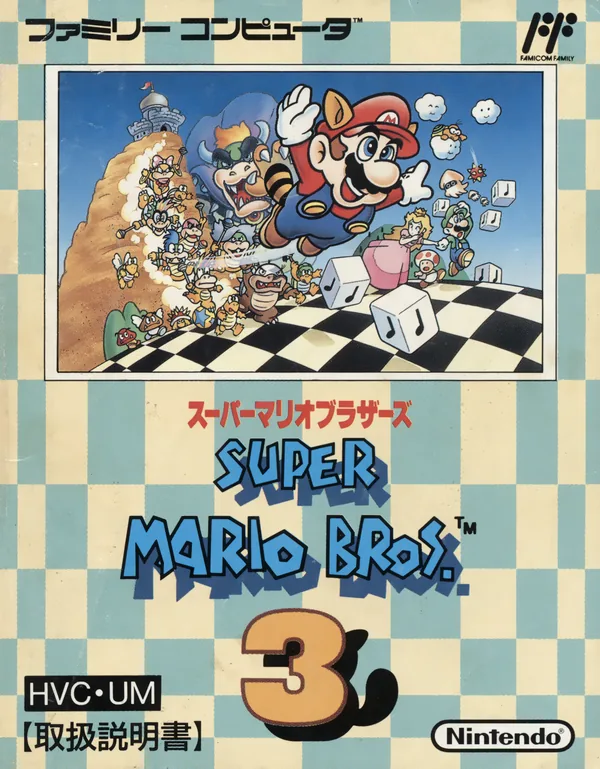
Released on the Famicom in 1988. The North American booklet tells the story: Bowser sent his seven children into the Mushroom World, where they stole the royal magic wand of each country and used it to turn its king into an animal. Mario and Luigi set out to win the wands back (Instruction Booklet p5).
These pages read the North American NES ROM: the world maps, level layouts, enemy lists, game text, and score table all come from it. There are eight worlds, with 6, 5, 9, 6, 9, 10, 9, and 2 numbered levels. Japanese names come from the Famicom manual. There is no Famicom ROM in our set yet, so the game's Japanese text is not on the site.
Worlds
Books and ROM
- The Strategy Guide and the NES manual give the worlds different English names; only World 1, Grass Land, is the same in both. The ROM has no world names.
- The Strategy Guide's P-Wing is the Magic Wing in the Instruction Booklet (p24).
- The Fire Flower makes Fire Mario in the booklet and Fiery Mario in the Strategy Guide (p5).
- Both books spell it Racoon Mario; the king in the ROM says "kind raccoon".
- The booklet's Boom Boom is BOOM-BOOM in the Strategy Guide.
- The White Mushroom House coin counts are the Strategy Guide's. Where the ROM keeps them is not found yet.
- The ROM spells the card game line "Miss twice and your out!".
In the 百科 (2015)
Things that first appeared in this game, and memorable scenes. Many are easy to miss in normal play.
本作で初めて登場する要素や印象的なシーンを紹介。普通に遊んでいたのでは気づかないようなものも多い。
Our translation of スーパーマリオブラザーズ百科 任天堂公式ガイドブック (Shogakukan, 2015) p42
Slopes in the ground. Slopes were added to the level ground. With them, levels could rise and fall and look more varied. Mario can also slide down a slope to beat enemies.
地形に坂道が追加 コースの地形に、斜めの坂道が追加された。これによって起伏を示すことが可能になり、コースの表情がより豊かになった。坂道を滑って敵を倒すことも可能。
Our translation of スーパーマリオブラザーズ百科 任天堂公式ガイドブック (Shogakukan, 2015) p42
The first auto-scroll levels. Up, down, and sometimes at an angle. Levels where the screen moves on its own appear for the first time. Mario can neither go ahead nor go back, so he has to act inside the screen he is given. Being caught between the edge of the screen and an obstacle costs a life.
強制スクロールコース初登場 上へ、下へ、ときには斜めへ。画面が自動的に進む強制スクロールコースが初登場。先へ進むことも戻ることもできないので、限られた画面の中でアクションを行うことになる。画面の端や障害物に挟まれるとミスとなる。
Our translation of スーパーマリオブラザーズ百科 任天堂公式ガイドブック (Shogakukan, 2015) p42
The old Mario Bros. game. With two players, stand on Luigi's (or Mario's) icon on the map and press A to play the old Mario Bros. game. It is based on the Famicom game Mario Bros., a minigame two can play at once. Beat five enemies, or have the other player hit an enemy, to win and take the next move on the map. Players can also attack each other and take the other's goal cards.
懐かしのマリオブロスゲーム 2人で遊んでいるとき、マップ上にあるルイージ(またはマリオ)のアイコンに重なってAボタンを押すと、懐かしのマリオブロスゲームを遊べる。ファミコンソフト『マリオブラザーズ』をモチーフとしており、2人同時に遊べるミニゲームだ。敵を5体倒すか相手が敵に当たると勝ちとなり、マップ上で次に行動できる。また、相手を攻撃することができ、ゴールカードを奪うことも可能。
Our translation of スーパーマリオブラザーズ百科 任天堂公式ガイドブック (Shogakukan, 2015) p42
The strange white floor. Crouch on a white floor for a while and Mario goes behind the background, where enemy attacks do not reach him. It works in five places: W1-1, W1-3, W3-10, W5-7, and W7-8. Go past the goal in W1-3 while behind the background and Mario gets a whistle.
不思議な白い床 白い床でしばらくしゃがんでいると背景の裏側へ移動でき、敵の攻撃を受けなくなる。W1-1、W1-3、W3-10、W5-7、W7-8の5か所で可能だ。なお、W1-3で裏側へ行った状態でゴール裏へ進むと、フエを入手できる。
Our translation of スーパーマリオブラザーズ百科 任天堂公式ガイドブック (Shogakukan, 2015) p43
A treasure ship full of coins!. Clear a level with the coin count on a pair of matching digits, the same digit as the tens of the score, and a Hammer Bros. on the world map turns into a treasure ship. It is an airship holding 188 coins. A Boomerang Bros. waits at the end, and beating it gives an item too.
コインを満載した宝船が出現! コースクリア時に、コインの数をゾロ目にし、その数字とスコアの十の位が同じになっていると、ワールドマップのハンマーブロスが宝船に変化。宝船はコインが188枚ある飛行船で、最後にはブーメランブロスが待ち受けており、倒すとアイテムも入手できる。
Our translation of スーパーマリオブラザーズ百科 任天堂公式ガイドブック (Shogakukan, 2015) p43
Player characters. Two brothers, Mario and Luigi, go on an adventure through the Mushroom World.
プレイヤーキャラクター マリオとルイージの2人の兄弟が、キノコワールドを冒険する。
Our translation of スーパーマリオブラザーズ百科 任天堂公式ガイドブック (Shogakukan, 2015) p34
Mario. Player 1. His red clothes and cap are his trademark.
マリオ 1プレイヤー担当。赤い服と帽子がトレードマーク。
Our translation of スーパーマリオブラザーズ百科 任天堂公式ガイドブック (Shogakukan, 2015) p34
Luigi. Player 2. His green clothes and cap are his trademark.
ルイージ 2プレイヤー担当。緑の服と帽子がトレードマーク。
Our translation of スーパーマリオブラザーズ百科 任天堂公式ガイドブック (Shogakukan, 2015) p34
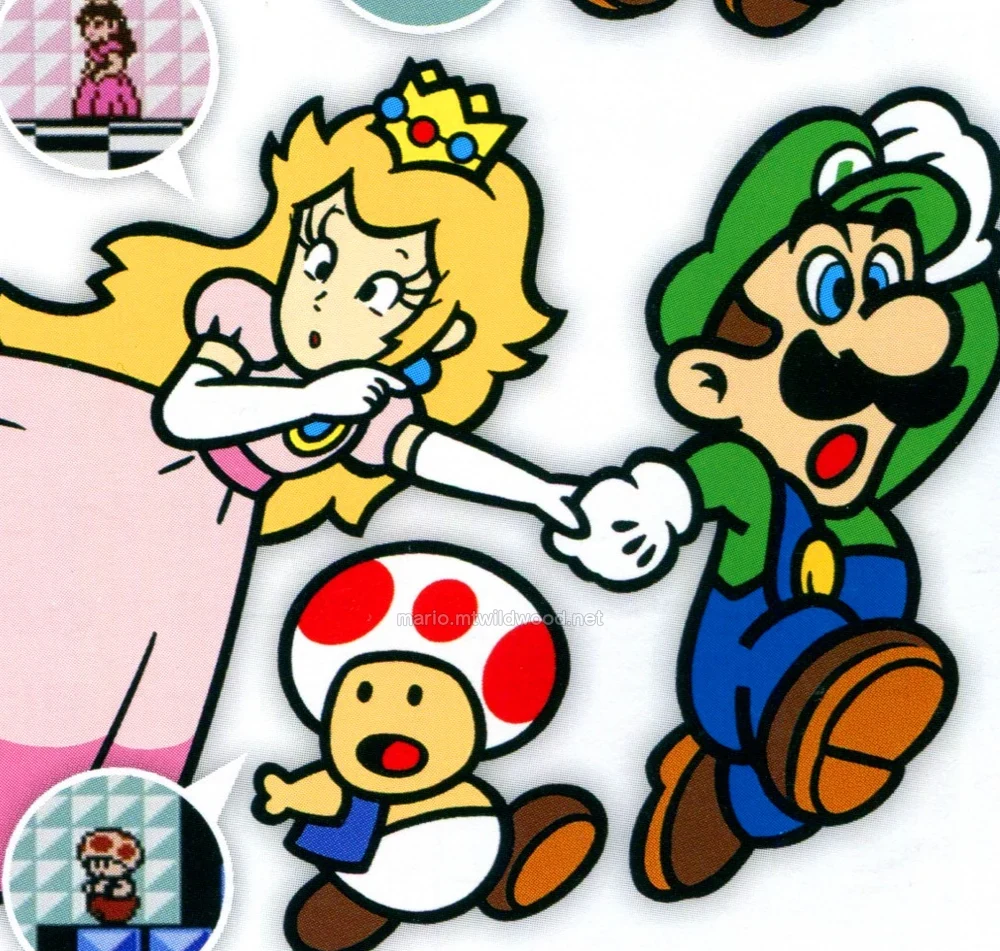
Princess Toadstool. The princess of the Mushroom Kingdom. When Mario saves a king, she sends a letter and an item.
ピーチ姫 キノコ王国のお姫様。王様を救うと、手紙とアイテムを送ってくれる。
Our translation of スーパーマリオブラザーズ百科 任天堂公式ガイドブック (Shogakukan, 2015) p34
Toad. Serves the king of each land. In Toad Houses he gives Mario useful items.
キノピオ 各国の王様に仕えている。キノピオの家で、便利なアイテムをくれる。
Our translation of スーパーマリオブラザーズ百科 任天堂公式ガイドブック (Shogakukan, 2015) p34
The kings. The king who rules each land. The Koopalings' mischief has changed each one into something else.
王様 各国を治める王様。コクッパたちのイタズラによって、姿を変えられている。
Our translation of スーパーマリオブラザーズ百科 任天堂公式ガイドブック (Shogakukan, 2015) p34
From the magazines
"The general plan for SMB 3 was to make it a game that players of all skill levels could enjoy."
Nintendo Power Volume 10 (Nintendo of America, January/February 1990) p22
the planners put plenty of bonus coins and 1-Ups in the early worlds of the game to help beginners.
Nintendo Power Volume 10 (Nintendo of America, January/February 1990) p22
Here, Mr. Tezuka, a director and planner of SMB 3, works on a CGCAD machine to design a picture of Mario.
Nintendo Power Volume 10 (Nintendo of America, January/February 1990) p22
Mr. Nakago, coding director on SMB 3, works with another programmer.
Nintendo Power Volume 10 (Nintendo of America, January/February 1990) p22
Super Mario Bros. 3 has more secrets, more tricks and more outrageous obstacles than the first two Super Mario Bros. games put together!
Nintendo Power Volume 11 (Nintendo of America, March/April 1990) p8
Nintendo, out late October, price not set.
任天堂 10月下旬発売 価格未定
Our translation of BIWEEKLY ファミコン通信 (ASCII, 29 July 1988) p142
In two parts: the map screen and the action screen.
マップ画面とアクション画面の2部構成
Our translation of BIWEEKLY ファミコン通信 (ASCII, 29 July 1988) p142
And you can slide down slopes, too.
ちなみにスロープは滑り降りられるのだ。
Our translation of BIWEEKLY ファミコン通信 (ASCII, 29 July 1988) p142
On sale Sunday 23 October, 6,500 yen.
10月23日(日)発売・6500円
Our translation of スーパーマリオブラザーズ3 マガジン Vol.1, ファミリーコンピュータMagazine 1988 No.17 supplement (Tokuma Shoten, 16 September 1988) p3
The maps of each panel shown here are only the basic parts; things like the bonus areas past the pipes and above the clouds are hidden. Most panels really are as big as ten screens by two screens, so with flying and going underground they spread out even further.
掲載している各パネルのマップは基本的な部分だけで、土管の先や雲の上のボーナス面などは隠してある。本当はほとんどのパネルが、10画面×2画面分の広さを持っているから、空を飛んだり、地下に潜ったりと、実際には更に大きな広がりがありそうだ。
Our translation of スーパーマリオブラザーズ3 マガジン Vol.2, ファミリーコンピュータMagazine 1988 No.18 supplement (Tokuma Shoten, 7 October 1988) p3
With 3M of memory the demo screen is elaborate and the music is first-rate too. It is good enough that you would not think it is the Famicom's sound. It feels like listening to an orchestra.
3Mの容量だけあって、デモ画面も凝ってるし、音楽もバツグン!「ファミコンの音とは思えない」スゴさなんだ。オーケストラを聞いてるような気分だぞ。
Our translation of スーパーマリオブラザーズ3 マガジン Vol.2, ファミリーコンピュータMagazine 1988 No.18 supplement (Tokuma Shoten, 7 October 1988) p3
Special feature: talk between Koichi Sugiyama and Shigeru Miyamoto. Talk held 27 September 1988 at Seibu Prime Studio Kinshicho. Between sets of the Famicom Music woodwind quartet concert, attended by game music staff from the makers among others, Mr. Sugiyama and Mr. Miyamoto held a talk.
特別企画 すぎやまこういち・宮本茂対談 '88・9・27 西武プライムスタジオ錦糸町にて/ファミコンミュージックの木管四重奏演奏会。会場にはゲームの音楽担当者をはじめ、メーカーの人もいっぱい。そして演奏の合い間に、すぎやまさんと宮本さんの対談が行われたのだ。
Our translation of スーパーマリオブラザーズ3 マガジン Vol.4, ファミリーコンピュータMagazine 1988 No.20 supplement (Tokuma Shoten, 4 November 1988) p34
Sugiyama: Which of the pieces played today are from games you made? Miyamoto: Let's see. ゼルダの伝説 and リンクの冒険, then スーパーマリオ and スーパーマリオ3.
すぎやま 今日のプログラムの中で、宮本さんが手がけたゲームは、どれとどれですか?/宮本 そうですね。「ゼルダの伝説」「リンクの冒険」、それに「スーパーマリオ」、「スーパーマリオ3」です。
Our translation of スーパーマリオブラザーズ3 マガジン Vol.4, ファミリーコンピュータMagazine 1988 No.20 supplement (Tokuma Shoten, 4 November 1988) p34
Miyamoto: When we make a game, at first we are not listening to music. About two thirds of the way through making it, the music drops in. At that point some games get far better and some do not change at all. As a rule, a game gets better once the music is in.
宮本 ゲームを作ってまして、最初は音楽を聞いてないんですよ。だいたいゲームを作っていて、3分の2ぐらいが終わったところで音楽がポンと入ってくる。そのときにものすごく良くなるものと、全然変わらないものとがあるんですよ。だいたい音楽が入ると良くなるのが当り前なんです。
Our translation of スーパーマリオブラザーズ3 マガジン Vol.4, ファミリーコンピュータMagazine 1988 No.20 supplement (Tokuma Shoten, 4 November 1988) p34
Shigeru Miyamoto profile: producer of the Mario series.
宮本茂プロフィール マリオシリーズのプロデューサー。
Our translation of スーパーマリオブラザーズ3 マガジン Vol.4, ファミリーコンピュータMagazine 1988 No.20 supplement (Tokuma Shoten, 4 November 1988) p34
Two players only: Mario Bros. fully analyzed. The two-player stages are a hidden treat of Mario 3. Besides the ordinary stage shown here and there, there are many other stages, and counting the small differences there are 8 kinds of stage in all.
2人プレイ専用 マリオブラザーズ大解析 「マリオ3」の隠れた醍醐味がこの2人プレイの面だ。あちこちで紹介されているフツーの面の他にもいろんなステージがあり、細かな違いも数えると全部で8種類のステージがある。
Our translation of スーパーマリオブラザーズ3 マガジン Vol.3, ファミリーコンピュータMagazine 1988 No.19 supplement (Tokuma Shoten, 21 October 1988) p17
Besides the Spiny, the characters include the old Sidestepper, the Fighter Fly, and the original fireball. The cast of Mario Bros. all turn up in style (with Slipice it would be perfect!).
登場キャラもトゲゾーのほかに懐かしのサイドステッパー、ファイターフライ、そして元祖ファイアボールなどが。「マリオブラザーズ」のキャストがゴーカに総出演(アイスが出れば完璧!)である。
Our translation of スーパーマリオブラザーズ3 マガジン Vol.3, ファミリーコンピュータMagazine 1988 No.19 supplement (Tokuma Shoten, 21 October 1988) p17
The rule is simple. Whoever beats enemies and collects more coins wins.
ルールは簡単。敵を倒したりしてコインを多く集めた方の勝ち。
Our translation of スーパーマリオブラザーズ3 マガジン Vol.3, ファミリーコンピュータMagazine 1988 No.19 supplement (Tokuma Shoten, 21 October 1988) p17
Spiny stage. Spiny stage: the familiar Spinies, five of them. Of course you cannot stomp a Spiny from above.
トゲゾー面 おなじみトゲゾーが5匹だ/もちろん上からふめないトゲゾー
Our translation of スーパーマリオブラザーズ3 マガジン Vol.3, ファミリーコンピュータMagazine 1988 No.19 supplement (Tokuma Shoten, 21 October 1988) p17
Fighter Fly stage: beat the flies while they are on the floor. Sidestepper stage: you have to hit them twice to beat them. Beat one and it gets angry and runs off fast.
フライは床にいる時に倒す/2回突かないと倒せないぞ/やっつけると怒って速く走り出す
Our translation of スーパーマリオブラザーズ3 マガジン Vol.3, ファミリーコンピュータMagazine 1988 No.19 supplement (Tokuma Shoten, 21 October 1988) p17
Coin stage. Coin stage: grab the coins that shoot out of the pipe, and watch out for the fireball. Another stage has hanging coins; take them quickly.
コイン面 土管から吹き出すコインを取れ! ファイアボールには気をつけることだ/ぶら下がったコインを早く取れ
Our translation of スーパーマリオブラザーズ3 マガジン Vol.3, ファミリーコンピュータMagazine 1988 No.19 supplement (Tokuma Shoten, 21 October 1988) p17
On the block stage, kick the ? blocks to find plenty of coins: 5 of the ? blocks hold a coin.
けとばしてたくさん見つけよう/?ブロックのうち5つにコイン
Our translation of スーパーマリオブラザーズ3 マガジン Vol.3, ファミリーコンピュータMagazine 1988 No.19 supplement (Tokuma Shoten, 21 October 1988) p17
Which way does it go?. Depending on which way a character that comes out of a block moves, you can lose it. Control it well and you get it safely. With a block you punch, it depends where you punch it; with a bump block or a note block, which side you hit it from.
キャラはどっちへ? ブロックから出現したキャラがどっちへ動くかで、せっかくのキャラが取れなくなってしまう場合がある。逆にうまくコントロールしてやれば、安全確実に手に入れられるわけだ。ブロックのパンチの場所、体当たりブロックや音符ブロックならどちら側から当たったかがポイントになる。
Our translation of スーパーマリオブラザーズ3 マガジン Vol.3, ファミリーコンピュータMagazine 1988 No.19 supplement (Tokuma Shoten, 21 October 1988) p18
The Mario 3 commercial, shown in print!. The commercial goes on airing after the release, so there will be many chances to see it. It runs on shows such as 加トちゃんケンちゃんごきげんテレビ, オレたちひょうきん族, F, and 火曜ワイドスペシャル.
マリオ3CM誌上上映会! CM自体は発売後も引き続き放映されるから、何かの機会に見るチャンスも多いかもね。放映番組は「加トちゃんケンちゃんごきげんテレビ」「オレたちひょうきん族」「F」「火曜ワイドスペシャル」など。
Our translation of スーパーマリオブラザーズ3 マガジン Vol.3, ファミリーコンピュータMagazine 1988 No.19 supplement (Tokuma Shoten, 21 October 1988) p26
Frames from the animated commercial: Mario storms the castle where the 子クッパ are; "A new adventure has just begun" as the stairs crumble; a close shave as he turns into Raccoon Mario and escapes; the 子クッパ's airship; "Get stronger. A technical fantasy game."
子クッパのいるお城に乗りこむマリオ…/「新しい冒険が今始まった」崩れる階段/間一髪! しっぽマリオに変身して脱出/子クッパの乗った飛行船!! 追いかけろ/強くなる。テクニカルファンタジーゲーム
Our translation of スーパーマリオブラザーズ3 マガジン Vol.3, ファミリーコンピュータMagazine 1988 No.19 supplement (Tokuma Shoten, 21 October 1988) p26
Books
- スーパーマリオブラザーズ3 instruction booklet (Nintendo, 1988)
- Super Mario Bros. 3 Instruction Booklet (Nintendo of America, 1990)
- Nintendo Power Strategy Guide: Super Mario Bros. 3 (Nintendo of America, 1990)
- スーパーマリオブラザーズ3 完全攻略テクニックブック 1 (Tokuma Shoten, 1988)
- スーパーマリオブラザーズ3 完全攻略テクニックブック 2 (Tokuma Shoten, 1988)
- スーパーマリオブラザーズ3 完全攻略テクニックブック 3 (Tokuma Shoten, 1989)
- スーパーマリオブラザーズ3 完全攻略テクニックブック 4 (Tokuma Shoten, 1989)
- スーパーマリオブラザーズ3 完全攻略テクニックブック 5 (Tokuma Shoten, 1989)
- スーパーマリオブラザーズ3 必勝攻略法 完璧編 (Futabasha, 1989)
- スーパーマリオブラザーズ3 PART1, 必勝道場 18 (Kodansha, 1988)
- スーパーマリオブラザーズ3 PART2, 必勝道場 19 (Kodansha, 1989)
- まんがスーパーマリオブラザーズ3 完全攻略本 (Kodansha, 1989)
- スーパーマリオブラザーズ3 完ペキ版 (Keibunsha, 1989)
- スーパーマリオブラザーズ3 MAP & DATA Vol.2, マル勝ファミコン 21 supplement (Kadokawa, 1988)
- スーパーマリオブラザーズ百科 任天堂公式ガイドブック (Shogakukan, 2015)
- Nintendo Power Volume 10 (Nintendo of America, January/February 1990)
- Nintendo Power Volume 11 (Nintendo of America, March/April 1990)
- BIWEEKLY ファミコン通信 (ASCII, 29 July 1988)
- BIWEEKLY ファミコン通信 (ASCII, 11 November 1988)
- BIWEEKLY ファミコン通信 (ASCII, 3 February 1989)
- スーパーマリオブラザーズ3 マガジン Vol.1, ファミリーコンピュータMagazine 1988 No.17 supplement (Tokuma Shoten, 16 September 1988)
- スーパーマリオブラザーズ3 マガジン Vol.2, ファミリーコンピュータMagazine 1988 No.18 supplement (Tokuma Shoten, 7 October 1988)
- スーパーマリオブラザーズ3 マガジン Vol.3, ファミリーコンピュータMagazine 1988 No.19 supplement (Tokuma Shoten, 21 October 1988)
- スーパーマリオブラザーズ3 マガジン Vol.4, ファミリーコンピュータMagazine 1988 No.20 supplement (Tokuma Shoten, 4 November 1988)
- スーパーマリオブラザーズ3 マガジン Vol.5, ファミリーコンピュータMagazine 1988 No.21 supplement (Tokuma Shoten, 18 November 1988)
- スーパーマリオブラザーズ3 マガジン Vol.6, ファミリーコンピュータMagazine 1988 No.22 supplement (Tokuma Shoten, 2 December 1988)
- スーパーマリオブラザーズ3 マガジン Vol.7, ファミリーコンピュータMagazine 1989 No.3 supplement (Tokuma Shoten, 3 February 1989)