101Leafy researched the games.
Super Mario Bros.: The Lost Levels
スーパーマリオブラザーズ2
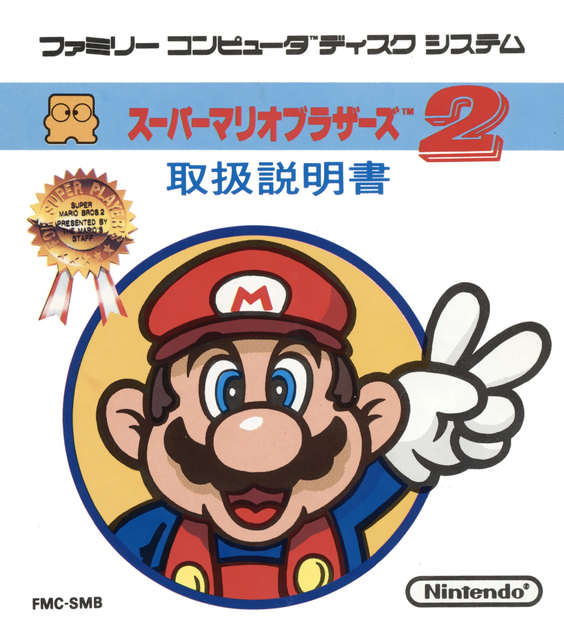
Released on the Famicom Disk System in 1986 for 2500 yen (ファミリーコンピュータMagazine 1986 No.10 (徳間書店, 1986) p.52). Every world has four areas, and the fourth is a castle (スーパーマリオブラザーズ2 instruction manual (Nintendo, 1986) p.7). There are 13 worlds (1 to 9 and A to D) with 52 areas in all (スーパーマリオブラザーズ2 完全攻略法, booklet in ファミリーコンピュータMagazine 1986 No.11 (徳間書店, 1986) p.67).
Each clear of 8-4 adds a star to the title screen, and after eight clears worlds A to D open (スーパーマリオブラザーズ2 instruction manual (Nintendo, 1986) p.6; ファミコン必勝本 No.005 (JICC出版局, 1986) p.72). Clearing 1-1 to 8-4 without a warp opens world 9 (ファミコン必勝本 No.005 (JICC出版局, 1986) p.72). The ending adds 100000 points for each player left (スーパーマリオブラザーズ2 完全攻略法, booklet in ファミリーコンピュータMagazine 1986 No.11 (徳間書店, 1986) p.116), and the game text says the same: 100000 PTS.ADDED FOR EACH PLAYER LEFT.
In the ROM the count is one byte at $D29F, written to the disk as the file SM2SAVE (bank 2, $C74A). Each ending adds 1, up to 24 ($C0B2). The title screen shows up to 24 stars in two rows of 12 ($C5A9). Our reading of $C480 is that starting with the A button held opens worlds A to D once the count is 8 or more. The cartridge conversion already holds 8 in that byte, so worlds A to D can be picked from the first start.
Hard mode (ROM $06CC) is on from the start in 4-4, worlds 5 to 9, and worlds A to D, 37 levels in all ($6E87). The only enemy placed for hard mode alone is one Podoboo in 5-4.
The disk image is not on hand. The numbers and maps on these pages are read from a mapper 40 cartridge conversion of the disk game, made after the fact. It is not a Nintendo release and not the original disk game; bank 7 still holds text from the Disk System BIOS. 101Leafy researched the game from that file and checked it against the books of the time. The level maps are built from the conversion's level data by its own code. Points are read from the score code as well and checked against the books.
World 1
World 2
World 3
World 4
World 5
World 6
World 7
World 8
World 9
World A
World B
World C
World D
World 9
In world 9 there is one life and no 1-ups (ファミリーコンピュータMagazine 1986 No.10 (徳間書店, 1986) p.70-71). The No.11 booklet says that Mario and Luigi are steered as in a water area, swimming with the A button, while the enemies move as they do on land (スーパーマリオブラザーズ2 完全攻略法, booklet in ファミリーコンピュータMagazine 1986 No.11 (徳間書店, 1986) p.98, our translation). The ROM gives the world 9 areas the water type.
In the ROM, entering world 9 sets the lives to 1 (bank 2, $C793). At game over the code at $707E checks for world 9 ($075F is 8); in world 9 it skips the CONTINUE and RETRY screen ($C1C2) and goes back to the title screen ($7088). In other worlds CONTINUE ($C203) starts again with 3 lives and clears the coins and score. This matches Nintendo Power Volume 52 (Nintendo of America, September 1993) p.19, which says there are no continues in world 9.
The screen printed on that page shows TIME with no number under it. In the conversion the world 9 headers hold 400, and the timer code has no special case for world 9: the header's setting is looked up in the table at $6F6D when a level starts ($6FB8), and the time counts down as in every other world ($82BB). So the ROM and the book's screen differ here. The 9-1 screen in スーパーマリオブラザーズ百科 (小学館, 2015) p.30 does show TIME 305, which fits a timer counting down from 400. The disk game could not be checked.
World 9's areas are in bank 2, but bank 2's copy of the parser tables is the same as bank 3's and does not reach them. The maps were rebuilt with bank 1's tables over bank 2's level data. That is a trait of the cartridge conversion, not of the disk game.
Warp zones
| Level | To | ROM |
|---|---|---|
| 1-2 | World 2-1 | $D0DB |
| 1-2 | World 3-1 | $C29D |
| 1-2 | World 4-1 | $D114 |
| 3-1 | World 1-1 | $CE81 |
| 5-1 | World 6-1 | $CC29 |
| 5-2 | World 7-1 | $D116 |
| 5-2 | World 8-1 | $C29D |
| 8-1 | World 5-1 | $CC29 |
| A-2 | World B-1 | $CF73 |
| A-3 | World C-1 | $CB4E |
| B-4 | World D-1 | $CB4E |
Every pipe of a warp zone leads to the same world (ROM $7513, $AB9A, table $670C). The 8-1 warp zone is in the same area as the end of 5-1, but from 8-1 it leads to world 5.
Enemies
Items
In the magazines
"This game was previously only released in Japan as Super Mario Bros. 2. It's radically different and harder than the U.S. version of SMB 2."
"The Lost Levels offers a total of 13 different Worlds for Mario and Luigi to travel through and explore."
"Other than the color of their overalls, the Bros. look the same and their abilities aren't dramatically different, but Luigi can jump higher, so we recommend playing with Luigi when you first begin to play the game."
"Upon completion of World 8, if you haven't taken any Warp Zones along the way, you'll go straight to World 9."
"If you Warped, Worlds A through D come after you rescue the Princess in World 8. The Princess is waiting again at the end of World D-4."
"Using no Warps, you'll get to World 9. Once you've arrived there, the unlimited Continues rule goes out the window."
"Definitely different than the original SMB, The Lost Levels features Warp Zones that take you back instead of ahead to a higher World."
「まずこのマリオ2は2人では遊べない。なぜかってゆーと答は簡単、これは1人用に作られたゲームだからなのだ。」
"First off, this Mario 2 cannot be played by two. Why? The answer is simple: it was made as a one-player game." (our translation)
「マリオ2のルイージは以前より足の筋力がついたらしい。何しろすごいジャンプ力で、マリオではとても跳べない所までジャンプしてしまう。」
"Luigi in Mario 2 seems to have stronger legs than before. He jumps so well that he reaches places Mario could never jump to." (our translation)
「着地するとすべり出してなかなか止まらないのだ。」
"When he lands he slides and takes a long time to stop." (our translation)
"The Super NES grabbed the lion's share of software attention with Super Mario-All Stars being a hit with the players, especially the incredibly challenging Lost Levels."
Nintendo Power Volume 52 (Nintendo of America, September 1993) p.18 covers the Super Mario All-Stars version, where worlds A to D follow 8-4 if you warped. In the disk game they open after eight clears of 8-4 (スーパーマリオブラザーズ2 instruction manual (Nintendo, 1986) p.6).
Books
- スーパーマリオブラザーズ2 instruction manual (Nintendo, 1986)
- ファミリーコンピュータMagazine 1986 No.10 (徳間書店, 1986)
- スーパーマリオブラザーズ2 完全攻略法, booklet in ファミリーコンピュータMagazine 1986 No.11 (徳間書店, 1986)
- ファミコン必勝本 No.005 (JICC出版局, 1986)
- BIWEEKLY ファミコン通信 No.1 (ASCII, 20 June 1986)
- BIWEEKLY ファミコン通信 No.2 (ASCII, 4 July 1986)
- BIWEEKLY ファミコン通信 No.3 (ASCII, 18 July 1986)
- BIWEEKLY ファミコン通信 No.4 (ASCII, 1 August 1986)
- Nintendo Power Volume 51 (Nintendo of America, August 1993)
- Nintendo Power Volume 52 (Nintendo of America, September 1993)
- Nintendo Power Volume 54 (Nintendo of America, November 1993)
- スーパーマリオブラザーズ百科 (小学館, 2015)